New Year's Eve bingo
New Year's Eve bingo cards include called words, party moments, and resolution prompts. Choose a format that fits the guests and the point in the evening when you want to play. Review alcohol, fireworks, affection, late-...
How to plan a New Year's Eve bingo game
A New Year’s bingo game can be called by a host, marked as party moments happen, or used to start a conversation about the year ahead. Pick one of those jobs before choosing a card. It will tell you when to start, what counts as a mark, and how closely the squares need to be reviewed.
Choose the way guests will participate
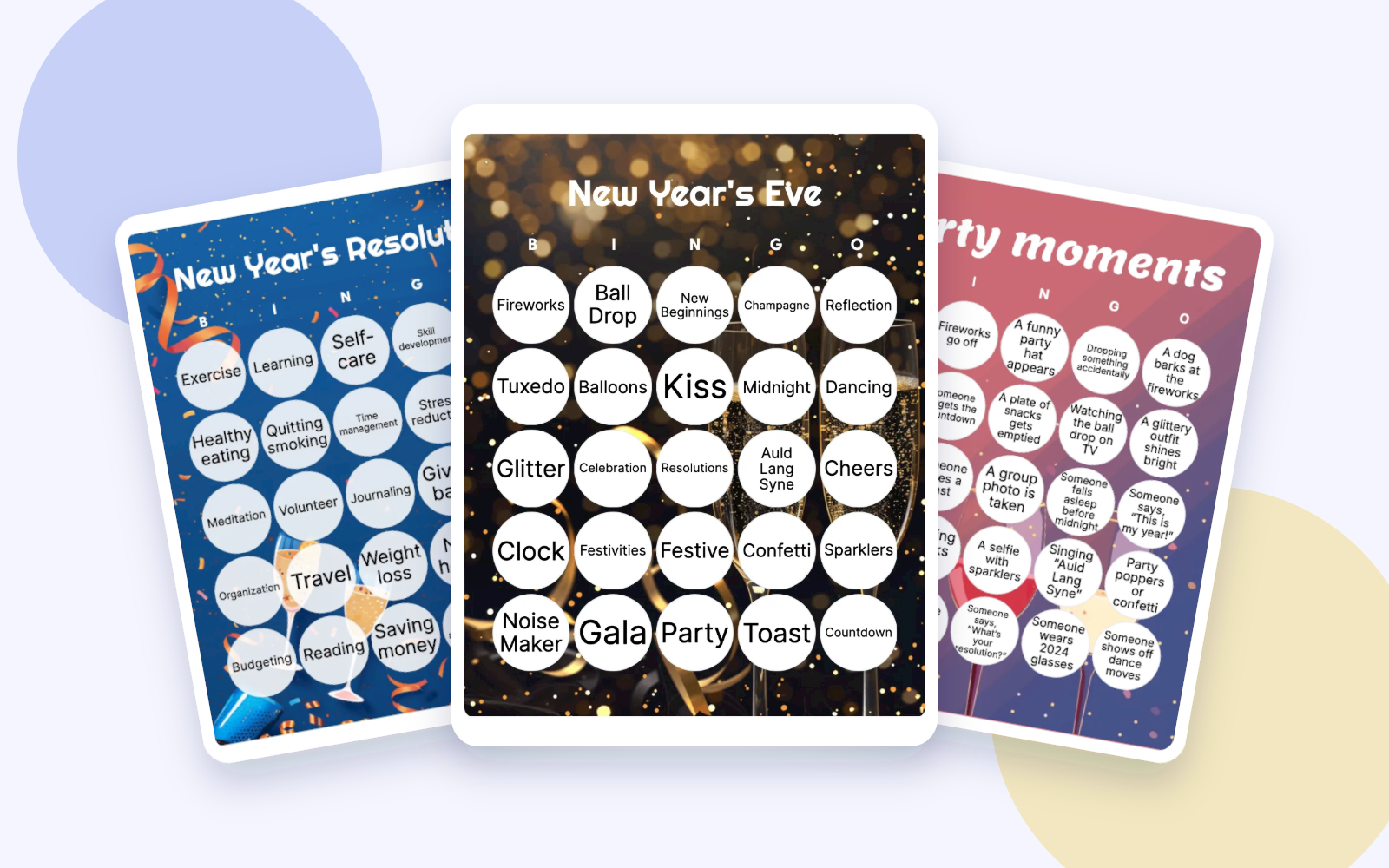
- New Year’s Eve includes familiar celebration words such as Countdown and Fireworks and can be used as a called game.
- Party moments includes events such as the countdown beginning, a spilled drink, and a midnight kiss, so it works as an observation card after careful review.
- New Year’s Resolution includes goals such as exercise, healthy eating, meditation, organization, and budgeting. It is better suited to optional discussion than prediction about another person.
A called round is easiest to contain within a short time slot. Observation play can run through part of the evening, but players need an agreed end time. Resolution prompts need an explicit pass rule because finances, health, habits, and personal plans are not comfortable topics for every guest.
Called play
Prepare one list containing every word or picture that may be called. Mark each item as it is used and pause long enough for guests to scan their cards. This format is the easiest choice when the game needs to finish before dinner, travel, a broadcast, or the countdown.
Observation play
Define which public moments count and who confirms them. A square such as “Countdown begins” is clear, while a broad party behavior may need interpretation. Players should never create a moment, pressure another guest, or spill, drink, kiss, or handle fireworks to complete a square.
Resolution and discussion play
Let players choose a prompt rather than assigning one to another person. They can talk about a goal, write privately, use a neutral substitute, or pass. The aim is to provide a structure for willing discussion, not to collect commitments from the room.
Match the card to the celebration
Review every square against the date, setting, age range, and guest list. Remove alcohol references for alcohol-free events and underage groups. Replace fireworks if they are not part of the celebration, and do not ask players to create or approach unsafe displays. A midnight kiss should never be treated as required behavior or as something guests must perform for a square.
The collection also includes Chinese New Year cards. Chinese New Year is a separate celebration with its own date and cultural context. Use those templates only when they fit the event being planned, and do not combine them with a January 1 party as interchangeable decoration.
Set a start and finish time
For parties with children or guests leaving early, finish a called round well before midnight. Observation cards can begin after arrival and end at a stated time, such as just before the countdown. If the game spans midnight, explain whether events after the countdown still count.
Keep the winning condition simple. One line is suitable for a short called round. For observation play, a fixed number of marked squares can be easier than waiting for a pattern that may never occur. Record called or accepted moments so a claim can be checked without arguing over the whole evening.
If people are joining remotely, decide which squares they can reasonably complete from their location. A moment inside the host’s room should not be the only route to a win. A called card is usually easier to keep consistent across locations because everyone receives the same calls at the same time.
Prepare the round
- Choose called, observed, or discussion-led play.
- Review every square and make substitutions for the guest list.
- Set the start, finish, and winning condition.
- Explain how disputed moments and skipped prompts will be handled.
- Prepare cards with the printing guide, or use the online play guide for remote guests.

Make participation easy to decline
Players should be able to skip a resolution prompt, alcohol reference, public display of affection, or personal question without losing the game. Use neutral substitutes prepared in advance, such as “someone checks the time,” “a favorite song plays,” or “name something you would like to learn.”
Do not require photographs or proof involving other guests. For observation play, the host can confirm whether a public moment counted. If two players disagree, use the host’s ruling for every card and rewrite the square before the next game.
Plan for children and early departures
Use familiar words or pictures, run a short round earlier in the evening, and remove squares based on alcohol, midnight, relationships, or unsafe celebration activities. Mixed-age groups can play in pairs, but each child should still be able to decline a prompt or activity. If guests may leave at different times, finish the competitive round before departures begin or state a fixed check time.
Handle the unpredictable evening
- Few observation squares occur: end at the stated time and award the win to the most marks, if that rule was announced in advance.
- A prompt feels personal: replace it without discussion or penalty.
- Guests arrive after the start: give them a fresh card for the remaining period or let them join the next round.
- The game competes with the countdown: stop marking and resume only if the finish rule allows it.
The game should support the celebration, not control it. A well-matched format, a clear end time, and a card reviewed for the guest list are enough to keep the round manageable.
Frequently asked questions
When should New Year's Eve bingo start?
Can children play New Year's Eve bingo?
How should I use resolution bingo cards?
Are Chinese New Year cards the same as New Year's Eve cards?
Generate bingo cards,
your way
Unleash your creativity with our versatile generator that simplifies the creation of personalized cards featuring text, emojis, and images!