Exercise & fitness bingo
Exercise and fitness bingo includes cards for observing movement, noticing things on a walk, and performing familiar activities. Decide whether players will watch or move before choosing a card, then check ability, space...
How to choose and run exercise bingo safely
Exercise and fitness bingo can be an observation game or a movement activity. That distinction matters. A walking card may ask players to notice things around them, while a movement or yoga card can ask them to perform an action. Choose the participation type first, then review every square for the people, space, equipment, and instruction available.
Choose observation or movement play
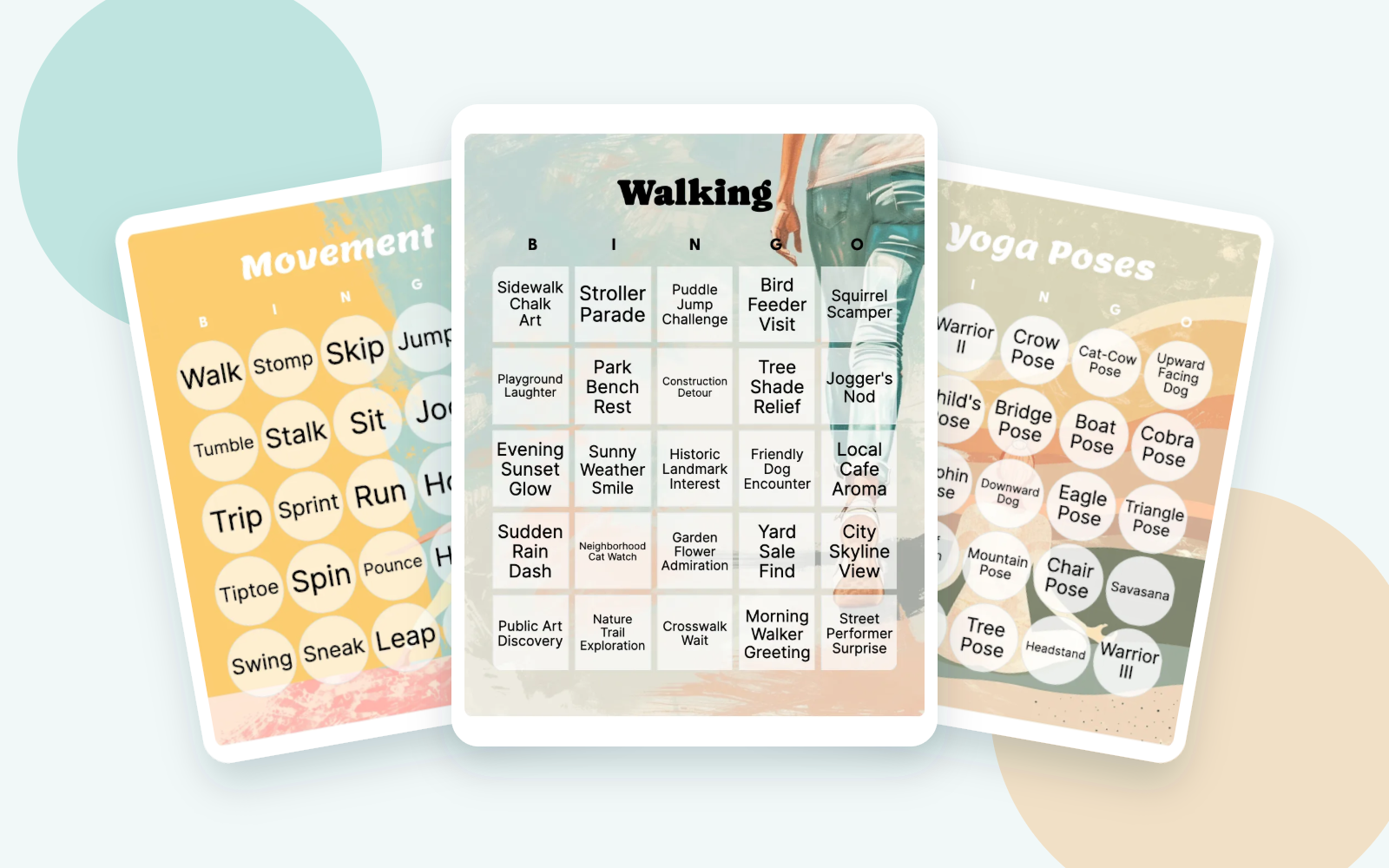
- Walking includes observations such as a friendly dog, a neighborhood cat, a stroller, and garden flowers. It can add noticing prompts to an established safe route.
- Movement includes actions such as walk, tumble, trip, tiptoe, and swing. Each word needs interpretation and a suitability check before use.
- Yoga Poses includes named poses such as Downward Dog, Warrior I, Warrior II, Warrior III, and Child’s Pose. Use only movements participants already know or that are led by an appropriately qualified person.
Observation play does not require a player to complete an exercise. Movement play does, so it needs opt-outs, substitutions, space checks, and a clear statement that marking the card is never more important than stopping.
Walking observation cards
Choose a familiar route that the organizer has checked. Players should look up and stop in a safe place before marking a card. Seeing a dog, cat, stroller, or garden flower never requires approaching a person, animal, home, or garden. The observation counts from a respectful distance.
General movement cards
Words such as tumble, trip, swing, and run can be interpreted in unsafe or unintended ways. Define each active square, remove accidental or unsuitable actions, and replace anything that does not fit the room or group. The card title is not a movement plan.
Yoga and named exercise cards
A name on a square does not show how to enter, hold, or leave a pose. Use a card only with movements participants already know or within a session led by an appropriately qualified person. The qualified leader decides what is included and what alternatives are offered.
Review every square for suitability
Consider mobility, balance, experience, clothing, footwear, available space, surfaces, equipment, and the need for rest. Remove actions that are unfamiliar, unclear, or unsuitable for anyone expected to take part. Avoid improvised instruction for complex movements.
This page cannot determine whether an exercise is appropriate for an individual. Participants should follow their own limits and any qualified medical or exercise guidance they have. If a movement causes pain, dizziness, unusual shortness of breath, or concern, stop rather than finishing the square.

Make skipping and substitution normal
Prepare a lower-movement or observation alternative for each active square. A player might mark an equivalent seated action, describe the movement, spot it in a demonstration, or take a pass. Apply substitution rules without asking for personal medical information.
Do not eliminate people for opting out. Teams can share tasks, or the group can play for a collective pattern rather than an individual first place. Competition is optional and should not encourage speed, extra repetitions, or movements beyond the agreed activity.
Check the space and route
For indoor play, remove trip hazards and confirm that each action has enough room. Keep equipment stable and use it only as intended. For walking observation, choose a known route, account for weather and visibility, and keep attention on roads, crossings, other path users, and changing ground rather than on the card.
Online play still needs a safe local space. The host cannot see every hazard or assess every participant remotely, so use simple familiar activities and make observation-only participation available.
Keep cards, phones, and markers out of the movement area. If players need to look at a square, they should stop first. A timer can define the round, but it should not be used to push repetitions or shorten rest.
Set the rules
- State whether squares are observed or performed.
- Review each square and prepare substitutions.
- Choose an unhurried winning pattern and allow rest.
- Explain that anyone may skip or stop without penalty.
- Prepare cards with the printing guide, or follow the online play guide for remote groups.
Keep the host’s role clear
The host explains the game and checks marks. They should not diagnose, prescribe exercises, or pressure a participant to continue. If a qualified instructor is leading a class, their instruction and safety rules take priority over the card.
Check a claimed line
Ask the player to identify the completed squares without repeating the movements. For observation cards, a short description is enough unless another evidence rule was agreed in advance. Do not ask for health information or a demonstration to prove that a substitute was needed. Apply the same marking and substitution rules to every claim.
Respond to problems
- A movement is unfamiliar: skip it or use the prepared observation alternative.
- The room is too small: remove active squares or switch to observation play.
- Someone needs a rest: pause or let them rejoin later without losing eligibility.
- Competition changes the pace: remove the race and work toward a shared pattern.
A suitable exercise bingo game is flexible enough to stop, skip, or change course. The card suggests a structure; participants’ safety, comfort, and qualified guidance set the limits.
Frequently asked questions
Can exercise bingo be played without doing exercises?
What if a player cannot or does not want to do a movement?
Should exercise bingo be competitive?
Can a bingo card teach yoga poses or unfamiliar exercises?
Generate bingo cards,
your way
Unleash your creativity with our versatile generator that simplifies the creation of personalized cards featuring text, emojis, and images!